How a Solar Panel Turns Seawater into Drinking Water and Lithium
What if a single black panel could turn ocean water into something you can drink, pull valuable minerals out of the sea, and leave almost nothing behind?
That sounds like science fiction, but researchers at the University of Rochester have developed a solar-powered desalination panel that can do exactly that. The device converts seawater into fresh drinking water while recovering salts and valuable minerals, including lithium, one of the most important materials used in modern batteries.
Unlike conventional desalination systems that generate concentrated waste brine, this new solar evaporator separates fresh water and crystallized minerals with almost no waste stream. The technology could offer a new approach to both water scarcity and critical mineral recovery.
The Problem with Making Seawater Drinkable
Desalination is one of those technologies that always sounds simpler than it is. The ocean is full of water, so why not just take the salt out?
The challenge is what happens to everything you remove.
Reverse osmosis, the dominant desalination method today, pushes seawater through membranes under high pressure. It works well, but more than half of the incoming water can end up as concentrated brine. That leftover brine is saltier than the ocean itself, and disposing of it can create environmental challenges for coastal ecosystems.
Solar evaporators take a different approach. Instead of pressure and membranes, they use sunlight to evaporate water and leave dissolved salts behind. The problem is that seawater contains much more than ordinary table salt. Magnesium and calcium compounds gradually accumulate on the evaporation surface, forming a hard mineral crust.
Once that crust forms, evaporation slows dramatically and the system eventually stops working.
For years, solar desalination researchers have been forced to choose between generating waste brine or fighting persistent clogging.
The Rochester team found a way around both problems.
A Laser, a Black Surface, and a Coffee Stain
At the heart of the system is an ordinary sheet of aluminum foil transformed by an extraordinary manufacturing process.
Researchers etched the foil using a femtosecond laser. A femtosecond is one quadrillionth of a second, allowing the laser to sculpt microscopic structures into the metal without melting it.
The resulting surface gains two useful properties:
- It absorbs roughly 92 percent of incoming sunlight.
- It pulls water across its surface through capillary action, effectively wicking water uphill against gravity.
The truly clever part comes from a phenomenon you’ve probably seen on your own kitchen table.
When a drop of coffee dries, it often leaves a dark ring around the edge rather than a uniform stain. Scientists call this the coffee-ring effect. As water evaporates, liquid flows outward and carries dissolved particles toward the perimeter.
The Rochester team designed their solar evaporator to take advantage of this effect.
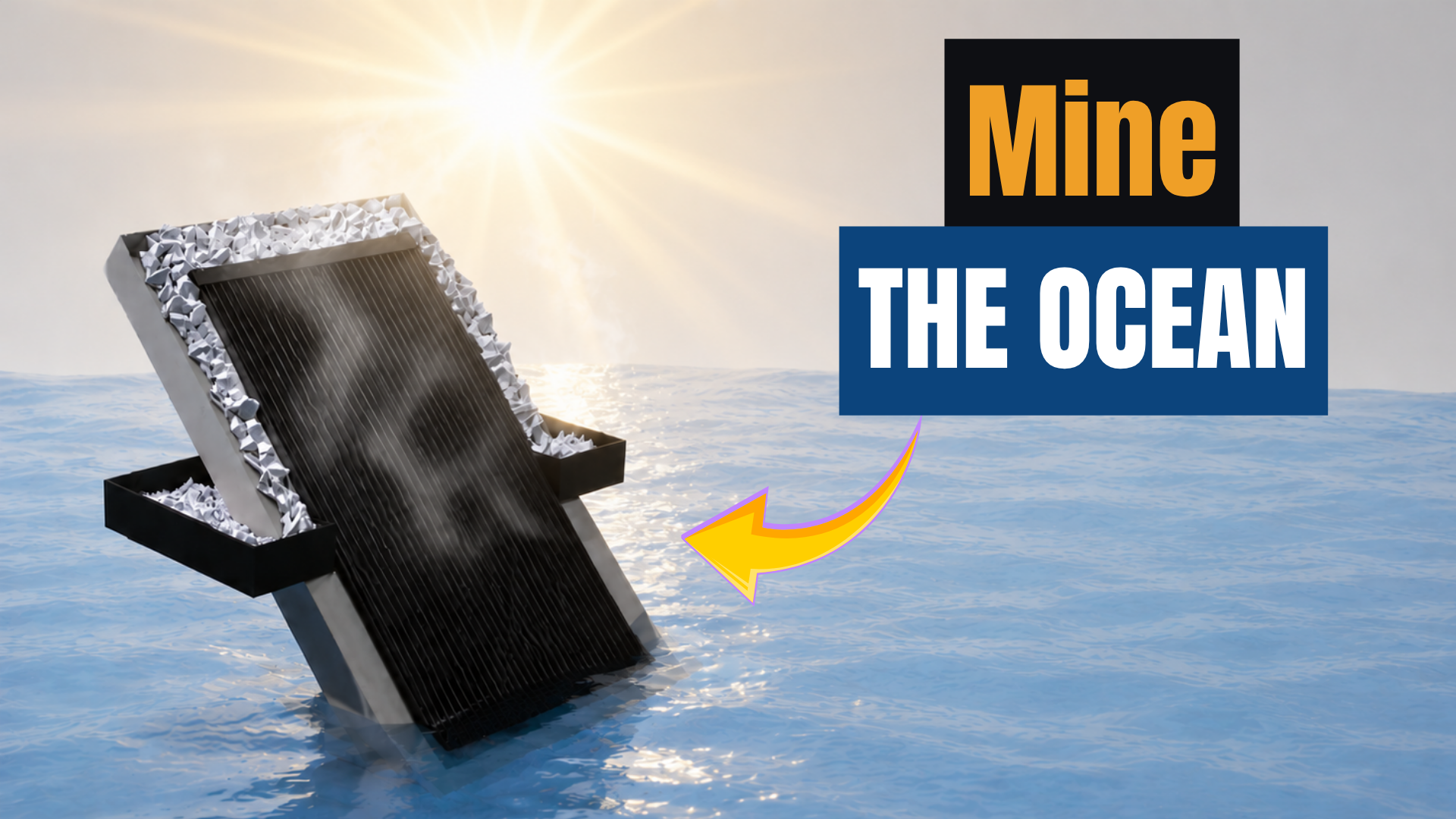
The center of the panel, where sunlight is concentrated, becomes the primary evaporation zone. As water evaporates, dissolved salts migrate toward the cooler outer edges of the panel and crystallize there instead.
The active evaporation area stays clean while mineral deposits collect safely away from the working surface.
In other words, the system continuously cleans itself as it operates.
From Waste to Resource
This is where the technology becomes more than a desalination device.
Instead of producing a concentrated waste stream, the panel recovers nearly all dissolved salts as solid crystals.
That material contains more than sodium chloride. Seawater also contains magnesium and trace quantities of valuable elements such as lithium, uranium, and gold.
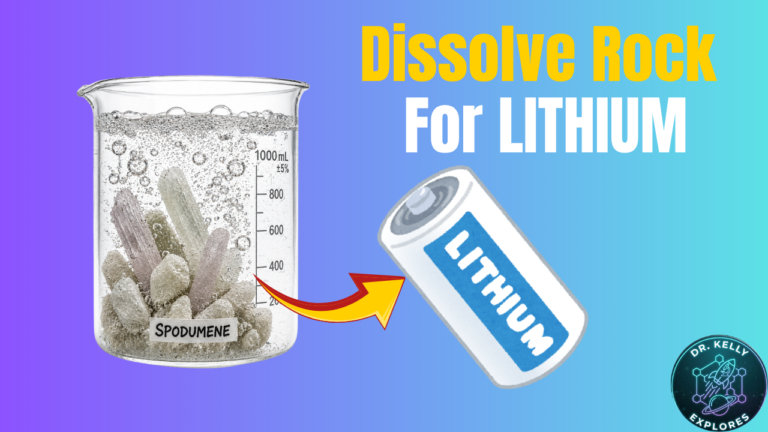
The panel does not automatically separate those elements from one another. However, the researchers demonstrated that coating parts of the surface with a lithium-selective material allows the system to preferentially capture lithium while other salts continue to crystallize elsewhere.
That is significant because lithium demand continues to grow as electric vehicles, grid storage systems, and consumer electronics expand worldwide.
Although seawater contains lithium only in very low concentrations, the oceans collectively hold an enormous amount of the element. Technologies that can selectively recover lithium during desalination could eventually provide a supplemental source of critical battery materials.
Fresh Water, Valuable Minerals, and Almost No Waste
The advantages of the system stack up quickly:
- Fresh drinking water from seawater
- Nearly complete salt recovery
- Minimal waste brine generation
- Resistance to mineral fouling and clogging
- Potential recovery of critical minerals such as lithium
The researchers tested the device using seawater collected from the Atlantic, Pacific, and Indian Oceans. In all cases, the panel maintained performance for an entire week without the severe clogging that typically limits solar evaporators.
While the technology is still at the research stage, it points toward a future where desalination plants could produce more than clean water. Instead of treating dissolved minerals as waste, future systems may view them as valuable resources.
If the concept can scale beyond the laboratory, the ocean could become both a freshwater source and a mineral mine at the same time.
Reference
- Tang, L., Singh, S. C., Wei, R., Xu, T. and Guo, C. (2026). Additive-free and brine-discharge-free solar-thermal desalination with simultaneous complete mineral mining from ocean water. Light: Science and Applications, 15, 246. https://doi.org/10.1038/s41377-026-02315-4
- Tang, L., Singh, S. C., Ma, M. and Guo, C. (2026). Rapid lithium extraction via solar-thermal interfacial evaporation with zero liquid discharge. Journal of Materials Chemistry A. https://doi.org/10.1039/d5ta08968a
- Auburn, L. / University of Rochester. (2026, May 27). New method turns ocean water into drinking water, without waste. University of Rochester Newscenter. https://www.rochester.edu/newscenter/what-is-desalination-definition-ocean-water-704732/