How Scientists Turned Ibuprofen Into a Heat Battery
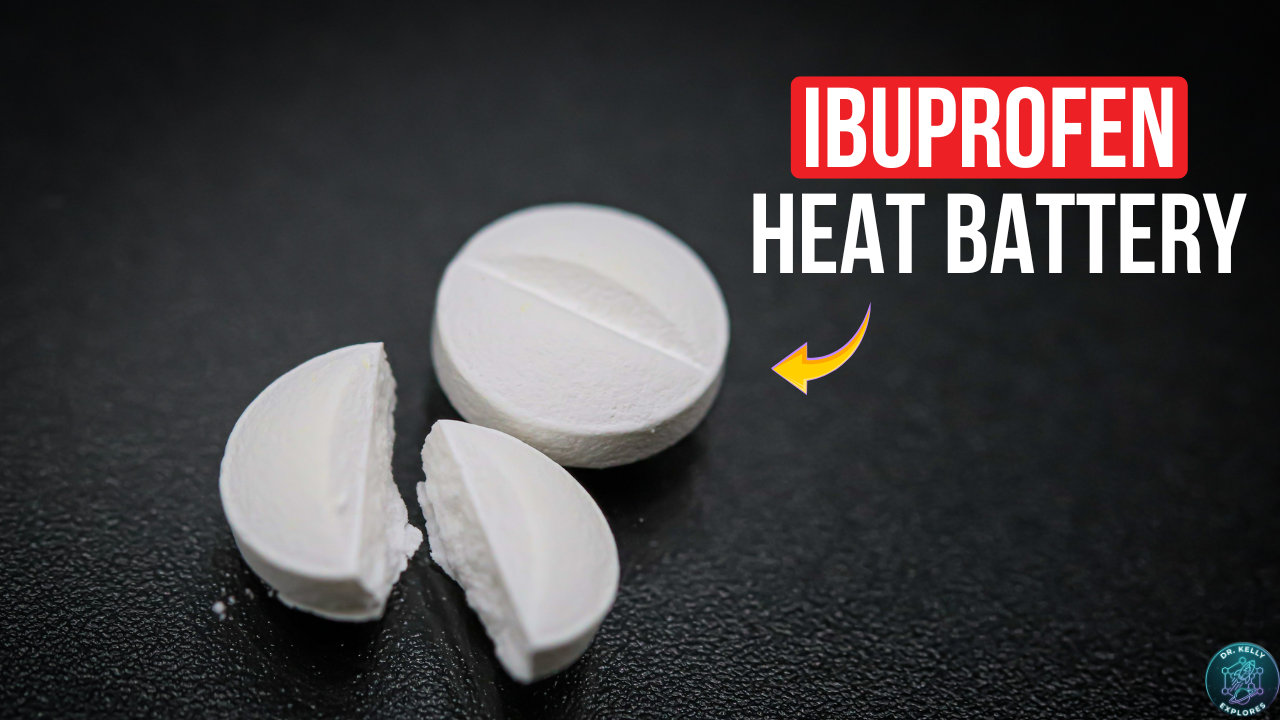
The painkiller in your medicine cabinet can do something surprising: soak up heat, hold onto it, and release it later exactly when it is needed. A team of researchers has shown that ibuprofen, of all things, may be one of the most durable materials yet discovered for storing low-grade waste heat. It is a strange result with a serious purpose, and it points toward a cleaner way to recover the enormous amount of heat that industry currently throws away.
The problem with storing heat
Factories, power plants, and engines release staggering quantities of low-grade heat, most of which simply vanishes into the air. Capturing that heat and reusing it later is one of the largest untapped opportunities in energy efficiency. The challenge has always been the storage material.
One promising approach is thermochemical energy storage, which locks heat into the chemical structure of a material rather than just warming it up. Many salts can do this. They hold water molecules inside their crystal structure, and when you heat them, the water is driven out and energy is stored. Add humidity back, the water returns, and the stored heat is released on demand. Think of it as a rechargeable battery that runs on water and warmth instead of lithium.
The catch is durability. The best inorganic salt hydrates, such as strontium chloride, store impressive amounts of energy but tend to self-destruct. Over repeated cycles they corrode their containers, crumble into powder, or absorb so much moisture that they dissolve into a puddle. That instability has held the technology back for years.
Searching a million crystals
To find something better, the researchers turned to organic salt hydrates, a class of materials built around carbon-based molecular backbones. They screened a database of roughly 1.1 million catalogued crystals, filtering by toxicity, cost, hydrate type, and molecular weight. The pool narrowed to pharmaceutical hydrates, then to just over a hundred candidates, and finally to one familiar compound: ibuprofen sodium dihydrate.
This kind of massive materials search is exactly where artificial intelligence is now being aimed. The authors used database filters rather than machine learning, but they explicitly note that AI and machine-learning methods should accelerate the discovery of the next generation of these materials.
Why ibuprofen works so well
Ibuprofen sodium salt holds two water molecules locked inside its crystal lattice. When gently heated, it gives up that water and rearranges its internal structure, storing energy through both a chemical change and a physical phase transition at once. That dual mechanism is part of what makes it interesting.
The standout feature is endurance. Because ibuprofen features a hydrophobic, organic backbone, it helps protect the material from the catastrophic failure modes—like liquefying or pulverizing—that destroy traditional mineral salts.. In testing, it survived 150 full charge-and-discharge cycles while retaining about 99.9% of its performance, with no deliquescence and minimal crumbling. By comparison, strontium chloride and calcium oxalate lost roughly 7% to 9% of their efficiency in fewer cycles.
The temperature range is a good fit too. Ibuprofen releases its water between 60 and 110 degrees Celsius, which lines up with the low-grade heat that many industrial processes waste every day.
The honest caveats
This is early-stage research, and a few limitations deserve mention. Ibuprofen stores less energy per unit of volume than the best inorganic salts, so it would need more space for the same amount of heat. Pharmaceutical-grade material is also expensive, though the authors argue that storage applications would not require costly drug-grade purity. And during cycling, the crystals expand and develop surface pores and cracks, which a real-world system would need to accommodate.
None of that erases the appeal. Ibuprofen does not need the additives and protective coatings that inorganic salts require to survive, which in practice claw back much of their volume advantage.
The bigger picture
The deeper message is not really about ibuprofen. It is that organic and pharmaceutical hydrates are a vast, largely unexplored playground for heat-storage materials, with tunable structures and mature manufacturing already in place. Ibuprofen is a proof of concept. Capture low-grade heat in a stable material like this, and yesterday’s wasted warmth could heat tomorrow’s buildings, with no battery and no fuel required.
—
Further Reading
1. Thangaraj, K. C., Chang, H. F., Lee, S. J., et al. (2026). Application of Ibuprofen Sodium Dihydrate for Thermochemical Energy Storage. Advanced Functional Materials. https://doi.org/10.1002/adfm.76373
2. Censi, R., Martena, V., Hoti, E., Malaj, L., & Di Martino, P. (2013). Sodium ibuprofen dihydrate and anhydrous. Journal of Thermal Analysis and Calorimetry, 111(3), 2009–2018.
3. Odukomaiya, A., Woods, J., James, N., et al. (2021). Addressing energy storage needs at lower cost via on-site thermal energy storage in buildings. Energy & Environmental Science, 14(10), 5315–5329.
4. Kiyabu, S., Girard, P., & Siegel, D. J. (2022). Discovery of salt hydrates for thermal energy storage. Journal of the American Chemical Society, 144(47), 21617–21627.