The Paint That Cools Itself in Direct Sunlight
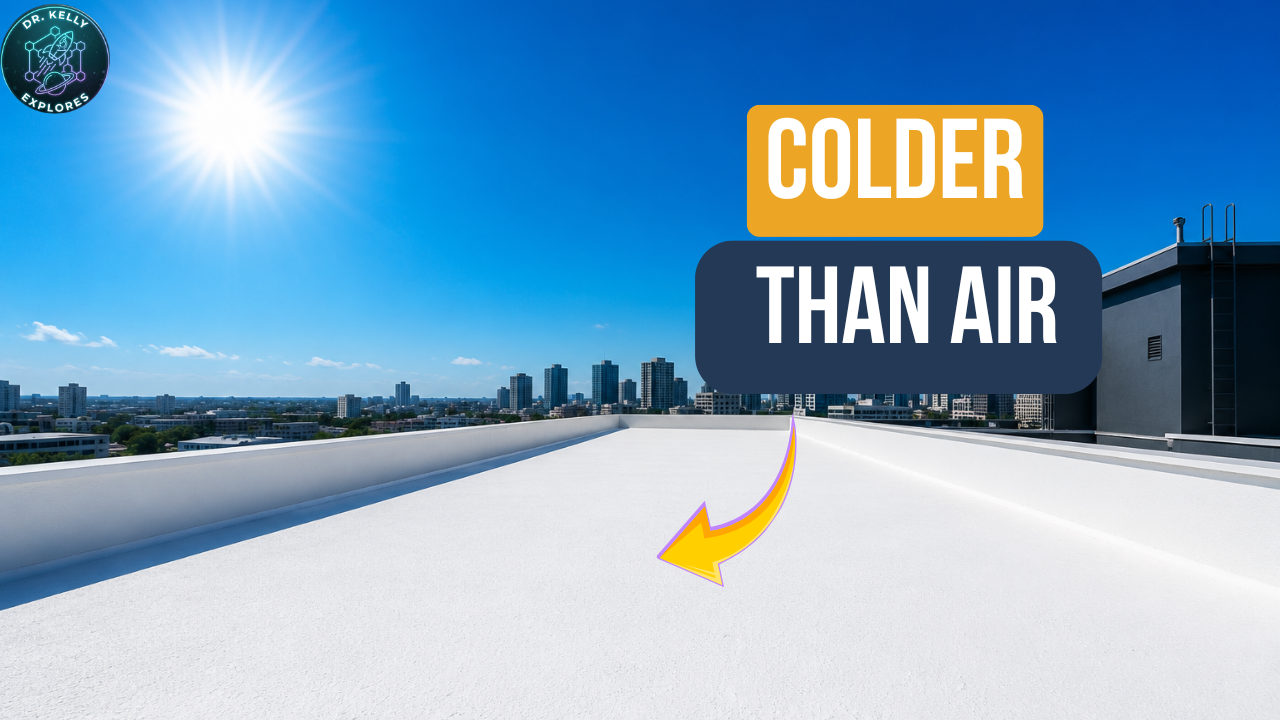
A few years ago, workers painted the roof and outer walls of Hong Kong Coliseum with an ordinary-looking white coating. It wasn’t meant to make the stadium look better. The goal was something far stranger: keep the building dramatically cooler. According to the company behind the technology, the coating can lower roof temperatures by 13 °C during peak summer [1].
That should not be possible. Leave any ordinary object in the sun and it gets hotter than the air, not colder. So how does a coat of paint pull off the opposite? The answer is a technology called passive daytime radiative cooling, and understanding it means understanding why ordinary white paint fails, what two jobs a cooling paint has to do at once, and where the field has gone in the last couple of years.
Why ordinary white paint isn’t enough
Everyone knows a white roof beats a black one. White paint reflects sunlight, and reflective “cool roofs” are a genuine weapon against the urban heat island effect. But here is the uncomfortable detail: ordinary white paint still gets hotter than the air around it.
The best commercial heat-reflective whites bounce back somewhere between 80 and 90 percent of sunlight. Ninety percent sounds excellent until you remember the sun delivers about 1,000 watts per square meter at peak. That missing 10 percent is still 100 watts pouring into every square meter of surface, continuously. The roof ends up warmer than the air — just less warm than a dark one.
The reason is the pigment. Almost all white paint gets its whiteness from titanium dioxide, which is superb at scattering visible light but has a hidden flaw: it absorbs ultraviolet. That absorbed UV turns into heat, and it also makes the pigment photocatalytic, slowly degrading the binder that holds the paint together. Conventional white paint has a ceiling it physically cannot cross. To drop below air temperature, a coating has to do two things at once, and do both nearly perfectly.
The two jobs
The first job is extreme reflection across the entire solar spectrum — ultraviolet, visible, and near-infrared, roughly 0.3 to 2.5 micrometers. To reach sub-ambient temperatures, a paint needs to reflect about 96 to 98 percent of sunlight and absorb only one or two percent.
The second job is radiating heat away, and here nature offers a gift. The atmosphere is mostly opaque to infrared radiation, except for one band between about 8 and 13 micrometers — the atmospheric window — where thermal radiation escapes straight to outer space, which sits at roughly 3 kelvin, just above absolute zero. A surface at room temperature happens to glow most strongly right around 10 micrometers, directly inside that window. A material engineered to emit strongly there is effectively piping its heat into the cold of deep space. Do both jobs well and the surface loses more heat than it gains, dropping below the surrounding air (known as *sub-ambient cooling*) even in full sun [2].
This is not a recent idea. The modern field began at Stanford in 2014, when a group led by Shanhui Fan and Aaswath Raman built a photonic mirror from alternating nanoscale layers of hafnium dioxide and silicon dioxide on silver. It was the first surface to stay below air temperature in direct sunlight [2]. The catch was that you could not put it in a can — it was grown layer by layer in a vacuum chamber. The leap that followed was turning that physics into something you could actually paint on [3].
How you actually build it
So how do you make a paint reflect 97 percent of sunlight? Not with a brighter dye, but with scattering. White, in this context, means light gets bounced back out before anything can absorb it. You achieve that by packing the paint with particles whose refractive index differs sharply from the binder around them, so every interface acts like a tiny mirror.
The secret is particle size. A particle scatters a given wavelength of light most effectively when it is roughly the size of that wavelength. Sunlight spans a huge range of wavelengths, so a single particle size leaves gaps in the spectrum. Pack the paint with particles across a broad range of sizes and every slice of the solar spectrum meets a particle tuned to scatter it. That broad size distribution is the real trick behind the whitest whites [4].
The infrared emission, meanwhile, comes almost for free from the chemistry. Many of the molecular bonds in common paint ingredients vibrate at wavelengths inside the atmospheric window. Acrylic binders emit strongly there, and so do certain fillers. The pigment problem — titanium dioxide’s UV habit — is solved by choosing a material with a wider band gap, one that simply lacks the energy levels to absorb ultraviolet or visible light. Purdue University’s well-known formulation replaced titanium dioxide with barium sulfate, packed to about 60 percent by weight, reaching 98.1 percent reflectance and cooling roughly 4.5 °C below ambient at noon. Spread over 1,000 square feet of roof, it sheds on the order of 10 kilowatts of heat — more than a typical home air conditioner — for zero power [4].
Broadly, there are two recipes. One loads the paint heavily with wide-band-gap particles: durable, but expensive. The other skips the pigment entirely and fills the film with microscopic air voids, which have an enormous refractive-index contrast with the surrounding polymer and scatter light just as well — a brilliant white made from nothing but polymer and holes [3]. That porous route is cheaper and cleaner, but a film full of pores can also soak up water and dirt, which brings problems we will return to.
Where it’s going
That is the how. The last couple of years have been about turning a laboratory curiosity into something that survives on a real roof.
Getting off fluorine. The highest-performing porous paints have leaned on fluoropolymers like PVDF, which are PFAS — the “forever chemicals” now facing regulation. A major thread of recent work is fluorine-free formulations. One 2025 study demonstrated a fully inorganic, water-based paint using alumina particles in a silicate binder, with no fluoropolymers or solvents, reaching over 96 percent reflectance and about 92 percent emissivity with strong resistance to UV and weathering [5].
Color. A white-only technology is a hard sell for cars, façades, or anything you actually look at, and color means absorbing some visible light, which fights the cooling. Researchers have found three ways around it. The first uses pigments that absorb only the narrow slice of visible light needed for their color while reflecting the near-infrared, where nearly half the sun’s energy resides — keeping colored surfaces several degrees cooler than conventional paints of the same shade [6]. The second uses fluorescent pigments that re-emit most of the absorbed light as light rather than turning it into heat, which can push effective reflectance in the emission band above 100 percent [7]. The third relies on structural color: one 2026 study created a biomass-derived ethyl-cellulose coating that, in a single casting step, self-separates as it dries into an ultra-thin top film producing color through optical interference — with no absorbing dye at all — over a porous layer that scatters sunlight, reaching 97 percent reflectance and cooling up to 9 °C below ambient, in full color [8].
Durability. A brilliant-white surface stays brilliant only until it gets dirty, and dust wrecks reflectance quickly. The recent fix is silica-based superhydrophobic topcoats that bead off water and let rain carry the grime away while barely affecting the coating’s optical performance, keeping the cooling effect intact through long outdoor exposure [9].
The winter problem. A paint that radiates heat all summer keeps doing it in January, when you would rather it did not. That has pushed researchers toward switchable coatings that turn cooling on and off with the seasons. A landmark 2021 result built a temperature-adaptive coating using vanadium dioxide, whose emittance automatically switches from about 0.20 below 15 °C to 0.90 above 30 °C — cooling hard when it is hot and backing off when it is cold [10].
Paint that makes water. Perhaps the strangest direction: if a coating holds a surface below the dew point, water vapor condenses on it. A University of Sydney team took a porous cooling paint, added a smooth topcoat so droplets roll off into a gutter instead of sticking, and left it on a rooftop for six months. It harvested up to about 390 milliliters of water per square meter per day, entirely passively, at a materials cost under ten dollars per square meter [11].
The catch
None of this is magic. The cooling power is real but modest — tens of watts per square meter, reaching toward a hundred only in ideal conditions. It is a supplement to air conditioning, not a replacement. And humidity is the enemy: water vapor closes the atmospheric window, so these paints shine in hot, dry climates and underperform in muggy ones. The high-pigment paints are durable but pricey; the cheap porous ones soil and degrade.
Still, the trajectory is clear. Purdue’s paint is reportedly approaching commercialization at a cost comparable to conventional paint, with thinner, lighter versions in development for cars, trains, and aircraft [12]. A growing list of companies—including i2Cool, Radi-Cool, SkyCool Systems, SPACECOOL, and SolCold—are already bringing radiative cooling technologies to market.
The next time you see a bright white rooftop, it might not simply be reflecting sunlight. It could be quietly sending heat across millions of kilometers of empty space through Earth’s atmospheric window toward the cold background of space. That’s a remarkable idea for something that comes out of a paint can.
References
[1] i2Cool. (2025, January 6). i2Cool powers green event management at Hong Kong Coliseum with electricity-free cooling technology. https://i2cool.com/company-news/46
[2] Raman, A. P., et al. (2014). Passive radiative cooling below ambient air temperature under direct sunlight. Nature, 515, 540–544. https://doi.org/10.1038/nature13883
[3] Mandal, J., et al. (2018). Hierarchically porous polymer coatings for highly efficient passive daytime radiative cooling. Science, 362, 315–319. https://doi.org/10.1126/science.aat9513
[4] Li, X., et al. (2021). Ultrawhite BaSO₄ paints and films for remarkable daytime subambient radiative cooling. ACS Applied Materials & Interfaces, 13, 21733–21739. https://doi.org/10.1021/acsami.1c02368
[5] Li, S., et al. (2025). An inorganic water-based paint for high-durability passive radiative cooling. Journal of Materials Chemistry C, 13(8), 4137–4144. https://doi.org/10.1039/D4TC04108A
[6] Chen, Y., et al. (2020). Colored and paintable bilayer coatings with high solar-infrared reflectance for efficient cooling. Science Advances, 6, eaaz5413. https://doi.org/10.1126/sciadv.aaz5413
[7] Fu, Y., et al. (2025). Photoluminescent radiative cooling for aesthetic and urban comfort. Nature Sustainability, 8(11), 1328–1339. https://doi.org/10.1038/s41893-025-01657-y
[8] Liu, Y., et al. (2026). One-step-processed bilayer ethyl cellulose for full-colour sub-ambient daytime radiative cooling. Nature Energy. https://doi.org/10.1038/s41560-026-02039-0
[9] Sun, Y., et al. (2023). Superhydrophobic SiO₂–glass bubbles composite coating for stable and highly efficient daytime radiative cooling. ACS Applied Materials & Interfaces, 15(3), 4799–4813. https://doi.org/10.1021/acsami.2c18774
[10] Tang, K., et al. (2021). Temperature-adaptive radiative coating for all-season household thermal regulation. Science, 374, 1504–1509. https://doi.org/10.1126/science.abf7136
[11] Chiu, M., et al. (2026). Passively cooled paint-like coatings for atmospheric water capture. Advanced Functional Materials, 36, e19108. https://doi.org/10.1002/adfm.202519108
[12] Purdue University. (2022, October). World’s whitest paint now thinner than ever, ideal for vehicles. Purdue News; and Coatings World. (2025, June 20). Purdue’s Xiulin Ruan develops world’s whitest and coolest paint. https://www.coatingsworld.com/exclusives/purdues-xiulin-ruan-develops-worlds-whitest-and-coolest-paint/