MIT’s New Lithium Process Could Reshape Battery Supply Chains
MIT researchers and startup Rock Zero have developed a low-temperature lithium extraction process using ammonium fluoride that cuts refining costs by roughly 40% while producing almost no waste.
Getting lithium out of hard rock is one of the dirtiest and most energy-intensive parts of battery manufacturing. A team at MIT may have found a way around that.
Their process eliminates the kiln entirely, operates below 100°C, and turns what used to be waste into three sellable industrial products. Rock Zero, the startup commercializing the technology, is now scaling the process in Boston.
But the interesting part isn’t just the chemistry. It’s what this could mean for the global battery supply chain.
The Problem With Hard-Rock Lithium
Most people associate lithium production with the salt flats of South America. But a huge portion of the world’s lithium comes from spodumene — a hard silicate mineral found across Australia, North America, and Europe.
The problem is refining it.
Conventional spodumene processing requires roasting the ore above 1,000°C in a kiln before leaching it with concentrated sulfuric acid. The roasting step changes the crystal structure of the mineral so lithium can be extracted.
That process is expensive, energy-intensive, and chemically messy.
It’s also one reason China dominates lithium refining. Even countries with large hard-rock lithium reserves often ship their ore to Chinese refineries for processing.
Changing that requires fundamentally different chemistry.
The Idea Started With Glass Etching Cream
About 25 years ago, MIT materials scientist Yet-Ming Chiang walked into a hardware store looking for glass-etching cream. The active ingredient was ammonium fluoride — a relatively mild chemical that dissolves silica, the main component of glass.
That detail eventually became the key insight behind the process.
Spodumene is also largely built from silica. Traditional hydrometallurgy targets the reactive metals first and leaves behind silica-rich waste. Chiang’s team reversed the logic: attack the silica first, and the mineral structure falls apart on its own.
That reversal is the core innovation.
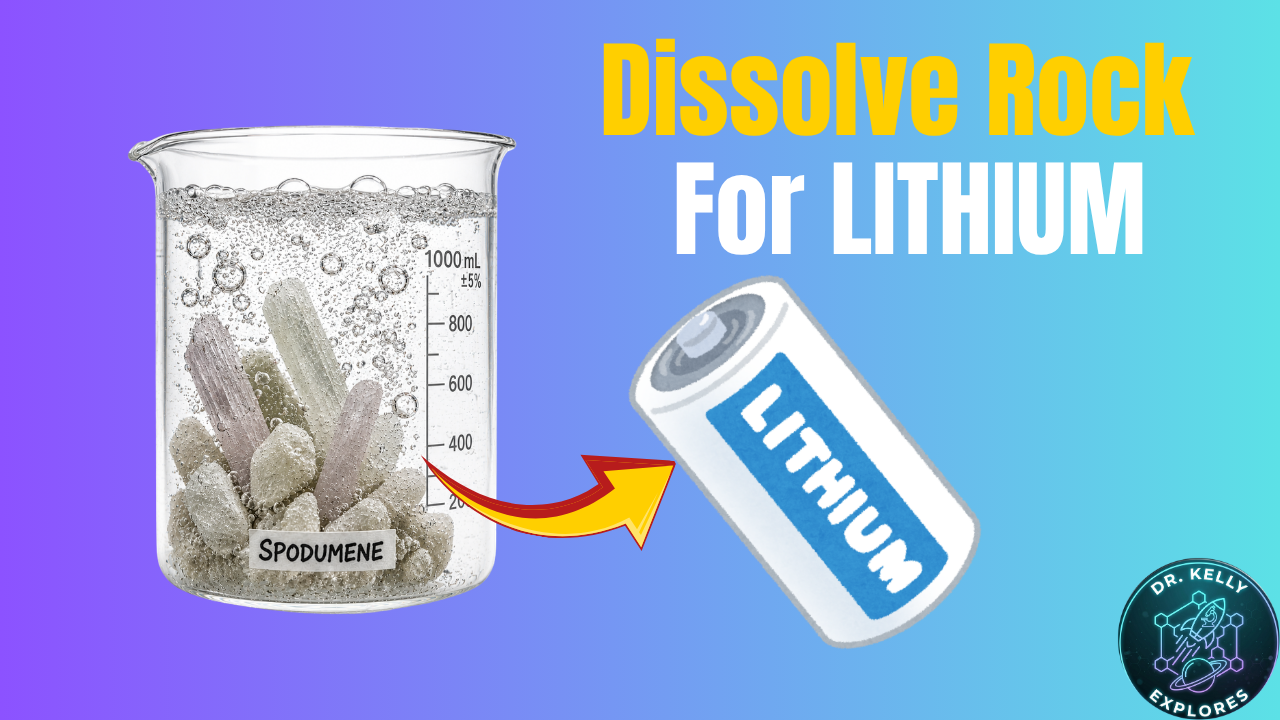
Using water and ammonium fluoride at temperatures below 100°C, the team dissolved spodumene and separated its three major components: lithium, aluminum, and silicon.
No kiln. No sulfuric acid roasting. Just stirred plastic tanks operating near room temperature.
Three Products Instead of One Waste Stream
What makes the process especially interesting is that almost nothing gets discarded.
The lithium stream is converted into battery-grade lithium carbonate. The aluminum becomes smelter-grade alumina. The silicon becomes reactive silica, which outperformed commercial silica fume by 61% in compressive-strength testing for concrete applications.
The process effectively converts what would normally become waste into co-products with industrial value.
Chiang describes the idea as “nose-to-tail mining” — using the entire ore body instead of extracting lithium and discarding the rest.
The reagent loop is also unusually efficient.
During dissolution, ammonia gas is released. Reapplying that ammonia regenerates the original ammonium fluoride solution while precipitating silica back out of solution. The team reported greater than 99.9% reagent recovery across multiple cycles.
Waste approaches zero.
The Economics May Matter More Than the Chemistry
The team’s techno-economic model estimates production costs around $5,160 per ton of lithium carbonate equivalent — roughly 40% lower than conventional hard-rock refining.
That’s important because hard-rock lithium has traditionally struggled to compete with South American brine extraction on cost.
The team also tested the chemistry on 17 different spodumene ore samples sourced globally. Lithium recovery exceeded 95% in every case.
Early processing runs reportedly took several days. The team has since reduced that to under 12 hours.
Whether those economics hold at industrial scale remains to be seen. Scaling chemical processes is rarely straightforward. Reagent sourcing, impurity handling, and integration with real mining infrastructure can become major bottlenecks.
Still, this is much further along than many battery-material breakthroughs typically are at this stage.
Why This Could Matter Geopolitically
By 2040, global lithium production likely needs to increase several-fold to support projected battery demand.
Hard-rock lithium deposits are abundant and geographically distributed. The refining infrastructure is not.
Today, much of the world’s spodumene still travels through Chinese processing infrastructure before entering the battery supply chain. A low-temperature refining process that can operate domestically changes that equation.
In theory, mines in Australia, Canada, or the American Southwest could refine ore locally, produce battery-grade lithium on-site, and generate additional revenue streams from alumina and silica co-products.
That changes both the economics and geography of lithium production.
From Lab to Pilot Scale
The work was published in Science in May 2026. The technology has since been spun out into Rock Zero, which is developing the process at MIT’s tough-tech incubator, The Engine, in Boston.
A pilot plant is already planned, with operations targeted for 2027.
One detail that stands out is the hardware simplicity. The process runs in conventional stirred plastic tanks without extreme pressures or exotic reactor systems. That may matter more than it sounds. Simpler hardware makes industrial adoption significantly easier.
Whether Rock Zero can scale successfully is still an open question. But the chemistry appears real, the economics are compelling, and the process addresses a very real bottleneck in battery manufacturing.
The lithium itself was never the hardest part.
The refining infrastructure was.
References
1. Mowbray, B., Hunt, C., et al. (2026). Low-cost, closed-loop extraction of battery-grade lithium from spodumene via fluoride hydrometallurgy. Science. DOI: 10.1126/science.aec4652 https://doi.org/10.1126/science.aec4652
2. MIT News Office. (2026, May 28). MIT researchers develop a low-cost technique to get lithium out of rocks. https://news.mit.edu/2026/mit-researchers-develop-low-cost-technique-lithium-from-rocks-0528
3. MIT Technology Review. (2026, May 28). How a new extraction process could unlock the world’s lithium. https://www.technologyreview.com/2026/05/28/1138096/lithium-extraction-rock-zero/
4. C&EN / American Chemical Society. (2026, June). Low-cost method to get lithium from rocks could lower dependence on China. https://cen.acs.org/energy/energy-storage/lithium-spodumene-extraction-battery/104/web/2026/06
5. MIT Sustainability. (2026). MIT researchers develop a low-cost technique to get lithium out of rocks. https://sustainability.mit.edu/article/mit-researchers-develop-low-cost-technique-get-lithium-out-rocks
6. The Brighter Side of News. (2026, May 31). New low-temperature process extracts battery-grade lithium with far less waste and energy. https://www.thebrighterside.news/post/new-low-temperature-process-extracts-battery-grade-lithium-with-far-less-waste-and-energy/
7. Interesting Engineering. (2026, May 29). MIT scientists unveil new method to extract lithium from hard rock at room temperature. https://interestingengineering.com/energy/mit-extract-lithium-from-hard-rock
8. Energy Storage News. (2026, June 1). MIT team develops room-temperature lithium process from spodumene. https://www.ess-news.com/2026/06/01/mit-team-develops-room-temperature-lithium-process-from-spodumene/